
Across the world, emerging researchers are pushing the boundaries of what we know about language learning and assessment. Each year, the IELTS Partners recognise a Master’s-level thesis that makes an outstanding contribution to the field of language testing.
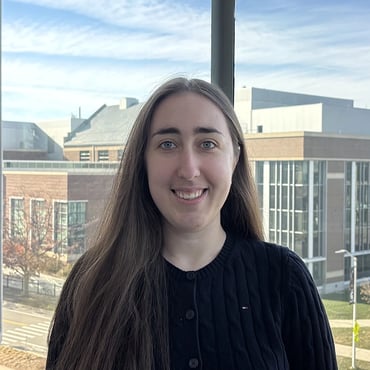
The 2025 Caroline Clapham IELTS Masters Award has been awarded to Elena Gorshkova from Michigan State University for her thesis, ‘Test takers’ attention to speakers’ nonverbal behaviors in an integrated, video-based listening test: An eye-tracking and interview study’.
Reviewers praised Elena’s research as ‘a rigorous, innovative study of nonverbal behaviour in video-mediated L2 listening’. They highlighted its clear research questions, strong theoretical framing, and smart mixed-methods design using eye-tracking, free recall and interviews. The panel also noted the study’s ‘actionable insights for test design and the multimodal construct’ and its strong potential for publication.
We spoke to Elena to learn more about her research and her journey into the field of language assessment.
Introducing Elena
Could you tell us a little about yourself?
My name is Elena Gorshkova, and I am currently a PhD student in the Second Language Studies programme at Michigan State University. I received my master’s degree in Teaching English to Speakers of Other Languages (TESOL) from Michigan State University as well. It was during my master’s programme that I became interested in the field of language assessment, especially after taking an assessment class in the very first semester of graduate school. Currently, language assessment is my main research interest, followed by eye-tracking.
Why did you apply for the Caroline Clapham IELTS Masters Award?
I saw the information in an email and I noted in my head that I wanted to apply. I thought it might be a meaningful way to share my work. Around this time, my advisor, Dr. Paula Winke, met with me and recommended this award to me as well. This encouraged me to submit an application.
How did you feel when you found out you’d won the award?
I couldn’t contain my joy and excitement! I remember that I’d just finished collecting data for my PhD project, opened my inbox to check emails and saw this great news. I immediately told my family and Dr. Paula Winke about this.
Can you tell us a bit about your thesis and what you found out?
My thesis examined test takers’ attention to nonverbal behaviours in a video-based (academic) listening test. I used eye-tracking technology to capture test takers’ real-time attention to different nonverbal behaviours.
Elena’s research explored where students naturally direct their attention – such as faces, eyes and gestures – when watching an academic lecture video in a listening test, and why these visual cues matter for how they understand what they’re hearing.
My findings show that when test takers watched academic videos, they attended to lecturers’ faces the most, followed by the eyes, mouth and gestures. Interviews demonstrate that test takers perceived facial cues and gestures differently; however, gestures were most salient to test takers.
What do you think the impact of your research will be?
I hope that my research findings will shed light on how nonverbal behaviours can impact L2 listeners’ engagement with videos. In particular, these findings can help us understand what specific nonverbal cues (e.g., facial expressions, eye contact, gestures) students attend to and find (un)helpful for their comprehension. This deeper understanding is important because it can inform teachers’ instructional practices on how to help learners use and interpret nonverbal behaviours in communication, thereby helping students become better listeners and allocate their attentional resources more effectively.
Elena’s insight into how students allocate their attentional resources underscores the importance of multimodal communication in academic settings. For higher-education staff, this means that deliberate use of gestures, facial expressions and clear visual signalling in lectures can actively support international students’ comprehension.
Who do you think will benefit from your research?
I hope that my research will be beneficial for both teaching and assessment. Teachers can use these findings to better select and design materials that feature speakers with different types of nonverbal cues. Students, in turn, can benefit from exposure to authentic speech that naturally includes both verbal and nonverbal channels. Lastly, these research findings can offer valuable insights for test developers as they consider how to incorporate multimodal input into video-based listening tests.
How do you hope to build on this research in the next stage of your career?
What I would like to do next is to extend this research on nonverbal behaviours and examine test takers’ individual differences and cognitive processes in video-based listening tests. This will help us better understand different learning styles and support students in their learning and assessment.
What are you planning to do with your scholarship?
With the help of this scholarship, I will be able to expand my research even further by conducting new studies, sharing my work at conferences and ultimately publishing my research.
I would like to express my gratitude to Dr. Paula Winke for her support and guidance as I was writing my master’s thesis. I would also like to thank the organisers for this award. It is a great honour to be chosen as the recipient.
About the Caroline Clapham IELTS Masters Award
The Caroline Clapham IELTS Masters Award is an annual award presented by the IELTS Partners (British Council, IDP IELTS and Cambridge University Press & Assessment). The award recognises exceptional Master’s-level research that contributes meaningfully to the field of language testing and encourages emerging scholars to pursue careers in assessment.
Applications for the 2026 award will open next year.
Recognising this year’s runners-up
The IELTS Partners and the research team would also like to commend the outstanding work of this year’s runners-up:
Runner-up: Haeng-A Kim (University of Cambridge)
‘An Exploration of the Language Assessment Literacy of Volunteer Tutors in the Adult English Literacy Programme in Australia’
Judges praised the thesis as ‘an insightful, well-framed study of volunteer tutors’ Language Assessment Literacy (LAL) in community programmes’ with ‘practical implications for LAL development’. They noted its strong theoretical foundations and potential for publication.
Runner-up: Ridmi Handapangoda (Lancaster University)
‘Scene behind the unseen: Special adjustments for visually impaired students at L2 English reading tests in the Sri Lankan university context’
The panel described the study as ‘a persuasive, well-referenced piece foregrounding fairness and accessibility’, valuing its lived-experience perspective and its practical implications for inclusive test design.