
When setting admissions requirements, the choice of English test is significant. Tests are not neutral – they influence the way students study and the skills they prioritise.
If that test promotes useful learning habits, students arrive well equipped for lectures, seminars and coursework. This is known as positive washback – and it means students come better prepared for academic life, easing their transition and reducing the demand on institutional support services.
For admissions decision-makers, the question is not only ‘does this test measure English proficiency?’ but also ‘what kind of preparation does it encourage?’ This perspective helps institutions admit students who are academically prepared and confident, with a greater chance of long-term success.
What is washback?
Put simply, washback is the effect a test has on teaching and learning.
- Positive washback occurs when preparing for a test encourages skills and habits that are genuinely useful beyond the exam itself – for example, practising critical thinking, academic writing and interactive communication.
- Negative washback happens when students are pushed towards rote memorisation or narrow exam-drilling strategies that do little to prepare them for rigorous academic study.
A useful way to think of washback is to see the test as a tool that incentivises different types of learning. If a test encourages more meaningful skills – like listening for meaning, writing extended essays or discussing ideas – students arrive at university with a more complete skill set. If it only requires them to memorise word lists or formulaic responses, students may be able to pass a test but struggle in real academic contexts.
Tests with positive washback ensure that applicants arrive with more than a score; they have the academic skills and confidence to thrive.
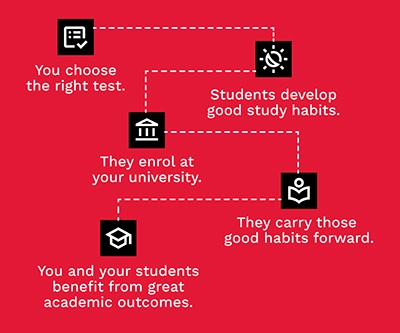
How preparing for the right test helps students build lasting study habits
Characteristics of a well-designed test
The following features matter most when evaluating which tests to accept:
1. Tasks that mirror real academic activities
A good test reflects what students will encounter in higher education – for example, contributing to tutorials, writing essays, interpreting data or presenting an argument.
- IELTS Academic includes writing tasks that ask test takers to describe charts and graphs, summarise information and construct evidence-based arguments – activities that align closely with university coursework.
2. Opportunities to practise productive skills
Success at university depends not just on understanding content but on communicating ideas clearly. Look for a test that requires extended writing and sustained spoken interaction.
- The IELTS Speaking test involves a conversation administered by a trained Examiner, encouraging authentic, natural responses, rather than scripted responses. This helps build confidence for seminars, presentations and daily university life.
3. Assessment of combined skills
University study demands multitasking – listening, reading, taking notes, synthesising ideas and then expressing them in writing or speech. A strong English proficiency test should measure all these abilities.
- When a test includes these features, it makes a measured difference to student performance in the first year of university. Research shows that IELTS test takers enjoy sustained academic success including GPA performance at York University (Barkaoui, 2025). While outcomes will naturally vary, the evidence indicates a clear link between IELTS preparation and achievement.
How a well-designed test can enhance study habits
A common assumption is that tests only add pressure and anxiety. Yet research suggests that preparing for a well-designed test can change study habits in positive ways. For example:
- Students shift from focusing purely on receptive skills (listening and reading) to also developing productive skills (speaking and writing) that are critical for university success (Allen, 2017).
- There’s considerable overlap in the teaching practices for IELTS Writing test preparation and English for Academic Purposes (EAP) instruction, so students often have the chance to engage in tasks that reflect academic study. (Green, 2006).
- Stronger English proficiency reduces the need for academic support costs and contributes to higher retention rates (Elder & O’Loughlin, 2003; O’Loughlin & Arkoudis, 2009).
Rather than being a hurdle, an effective test can act as a training ground. By simulating the kinds of tasks students will face later, preparation builds both skill and confidence. For institutions, this means students arrive not just ready to sit in a classroom but ready to participate and succeed.
The institutional impact of positive washback
When proficiency tests encourage students to develop a comprehensive set of academic skills, they not only set them up for success on their course but also lead to the following benefits for universities:
- Improved student experience – Students enter programmes with realistic expectations and practical study habits, reducing stress and improving wellbeing.
- Reduced academic support costs – Less reliance on remedial language support frees up institutional resources.
- Reputational benefits – Higher student success rates reinforce the institution’s reputation for quality and international student care.
In a crisis-driven enrollment landscape, understanding which proficiency tests offer positive washback is invaluable. Higher education leaders can use these insights to inform decisions about tests to accept, admissions requirements, resource allocation and programme design.
Takeaway for admissions decision-makers
Choosing the right English test is not just about meeting a formal requirement – it is about setting students up for success. The right test ensures they all arrive prepared for meaningful study.
IELTS Academic has been designed with this in mind. Its focus on authentic, communicative tasks means preparation helps students develop the study habits they will need at university. For institutions, this translates into better student outcomes, less pressure on support services and stronger reputational benefits.
The IELTS Language Assessment Literacy Guide provides universities with the practical tools they need to make confident, evidence-based decisions. Download the free guide to help you evaluate which language tests your institution should accept.
References and resources for universities
- Allen, D. (2017). Investigating Japanese undergraduates' English language proficiency with IELTS: Predicting factors and washback
- Barkaoui, K (2025). The relationship between English language proficiency test scores and academic achievement: A longitudinal study of two tests
- Elder, C. & O’Loughlin, K. (2003). Investigating the relationship between intensive English language study and band score gain on IELTS
- Green, A. (2006). Watching for Washback: Observing the Influence of the International English Language Testing System Academic Writing Test in the Classroom
- IELTS (2021). IELTS scores associated with early academic success for international students.