
Universities devote significant time and resources to providing academic support to international students once they arrive on campus. But many of the challenges students face – such as struggling with lectures, heavy reading loads and written assignments – begin long before enrolment.
What admissions teams must consider is how their choice of language test impacts the way students learn and prepare.
When testing aligns with academic demands, it can encourage study habits that contribute to long-term academic success. When it does not, universities must absorb more of the work required – academic and operational – to help students adapt.
In this article, we discuss how universities can help students adapt faster and mitigate many operational and academic risks by choosing the right language test.
The hidden cost of low English proficiency
Low or borderline English proficiency can place strain on almost every part of a university system. For example, research has uncovered many faculty concerns about how language barriers affect students’ academic understanding and create challenges for teaching and support. (Bruce et al, 2025)
Two months into the new academic year, faculty staff from your international business programme report that students who entered with a particular test score are struggling to participate in case study discussions and write coherent analysis reports. Elsewhere, teams are hoping to boost student recruitment by lowering entry scores. Even when you've chosen the right test and set scores carefully using evidence, circumstances change.
These competing pressures need careful handling and having a better understanding of assessment literacy helps you navigate them responsibly. Let's tackle the faculty concern first. When staff report that students at a particular score can't keep up, ask this critical question: is this about the score being too low or about students not getting adequate support once they arrive?
Understanding language assessment helps you separate these issues. If your evidence shows the test is fit for purpose and the score was set to match course demands, then raising requirements may not be the only solution. Sometimes the answer is investing in targeted English language support; academic writing centres, subject-specific tutoring or pre-sessional programmes.
Now the recruitment pressure. Lowering scores may boost admission numbers, but what happens next? If students arrive underprepared, your institution pays through lower retention rates, increased teaching burden, and reputational damage. Any score reduction must be paired with enhanced support systems. Changing scores isn't just a technical adjustment, it's a strategy decision affecting student experience, staff workload, and institutional reputation. Don't guess when adjusting scores – link changes to actual student outcome data.
If you must lower requirements, pair them with robust support systems. Recruitment gains vanish if students can't succeed. Responsible admissions protect both access and quality.
Thank you for watching this series. We hope we've provided you with tools and practical insights to help you make more informed, confident decisions for your institution. We also provide a wealth of materials to support you with these decisions, including research materials, sample tests, and score setting guides. Visit our website or contact your local representative for more information.
Across departments, these challenges increase staff workload and reduce the quality of academic interactions.
There are indirect costs too. When students struggle to follow lectures or express themselves, they’re more likely to experience frustration and anxiety. Over time, this can reduce engagement and retention, with consequences for institutional reputation.
On the other hand, research suggests that studying for assessments like IELTS is associated with improvements in overall English proficiency (Elder & O’Loughlin, 2003; Green, 2007; Nguyen, 2007; O’Loughlin & Arkoudis, 2009). Where admissions testing supports genuine language development and accurate assessment before arrival, fewer additional resources may be required to support international students with their studies.
Why preparation before arrival matters
As outlined in our article on how the right language test builds lasting study habits, universities can make a real difference by accounting for washback in admissions decisions. In other words, they must consider the effect a test has on how students learn and prepare.
When universities choose tests carefully and set appropriate entry scores, they gain a clearer understanding of applicants’ language ability and their readiness for study on an English-medium course. More importantly, students who prepare for such tests are more likely to arrive with stronger foundations in comprehension, vocabulary and written expression.
For instance, the IELTS Writing test involves practice that resembles university study. Research points to meaningful overlap between IELTS Writing tasks and English for Academic Purposes (EAP), which institutes offer to help international students build academic reading and writing skills (Green, 2006.) This suggests that well-designed admissions tests can align closely with the kind of language use expected on university courses, rather than sitting apart from it.
From passive study to academic habits
A key feature of positive washback is the way it shifts learning behaviour. Rather than focusing solely on isolated grammar or vocabulary drills, students are encouraged to engage with language actively and productively – reading extended texts, constructing arguments, and communicating ideas clearly.
Preparation for well-designed tests often involves transferable skills that are directly relevant to university study, such as:
- Skimming and scanning to gather information efficiently from academic texts
- Paraphrasing and summarising to communicate ideas accurately and avoid over-reliance on source language
- Predicting and inferencing to make sense of unfamiliar material
- Time management to work within deadlines and exam conditions
- Self-monitoring to reflect on performance and adjust strategies
Importantly, this kind of engagement depends on the nature of the test itself. Admissions teams may wish to ask test providers what evidence they can offer on washback – including how preparation activities relate to academic or professional contexts students are likely to encounter.
Academic confidence and reduced support needs
When students have practised productive skills before arrival, the benefits are visible across the institution. Students tend to participate more confidently in seminars, contribute to group discussions, and approach written assignments with clearer structure and purpose. This confidence can reduce reliance on writing centres and EAP programmes, allowing support services to focus on students with the greatest need.
Evidence also suggests that higher English proficiency is associated with better student welfare. Research has shown links between international students’ English language proficiency, social engagement and overall wellbeing in US universities (Brunsting et al). More confident students are typically less stressed, more engaged and better able to integrate into academic and social life.
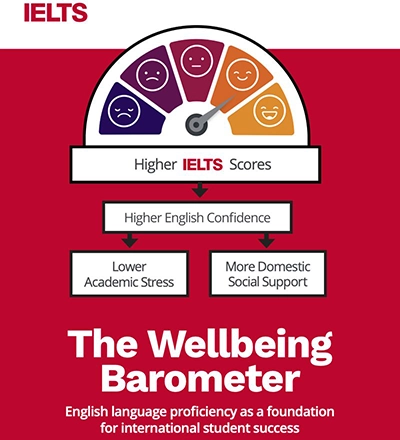
In this sense, this integration is supported less by the test preparation itself than by the language ability and learning strategies students develop during preparation and apply in real academic situations after their arrival.
Managing risk and protecting reputation
Admissions decisions are also risk-management decisions. While accessibility and widening participation are important goals, minimum language standards should be viewed as thresholds that protect institutions as much as students.
Universities can mitigate risks by developing rigorous entry standards that maintain academic quality, protect accreditation, and safeguard their reputation with stakeholders, partners, and regulators. They can rely on IELTS scores as reliable predictors of academic performance, especially when used alongside other criteria.
From a risk-management perspective, investing time in understanding what tasks make up each test, which skills they evaluate and how scores are set can reduce future costs associated with academic failure, complaints and reputational damage.
Specifically, these cost savings often show up in enrolment and retention. When universities admit international students who can cope with the linguistic demands of their courses, they can more easily sustain demand and protect recruitment budgets.
Takeaway for admissions and English departments
Thorough research into the English language tests an institution accepts is an investment in student success, reduced academic support costs, and long-term institutional reputation.
By choosing tests with demonstrated positive washback – and by setting entry scores informed by research – universities can support students before they arrive, rather than relying on costly interventions after enrolment.
For institutions looking to strengthen their decision-making, our Language Assessment Literacy guide and the IELTS scores guide (PDF, 6.28 MB, 27 pages) provide practical frameworks for evaluating tests and setting appropriate entry standards.
References and resources for universities
- Allen, D. (2017). Investigating Japanese undergraduates' English language proficiency with IELTS: Predicting factors and washback
- Bruce, E., Kinnear, S., Clark, Tony, Ottewell, Karen, & Dubey, M. (2025), The impact of English language test choice for higher education admissions in the UK
- Brunsting, N., Yu, Q., Smart, J., Bingham, W. P. (2022). Investigating linkages between international students’ English language proficiency, social–contextual outcomes, and wellbeing in US universities
- Elder, C. & O’Loughlin, K. (2003). Investigating the relationship between intensive English language study and band score gain on IELTS
- Green, A. (2006). Watching for Washback: Observing the Influence of the International English Language Testing System Academic Writing Test in the Classroom
- Green, A. (2007). Washback to learning outcomes: A comparative study of IELTS preparation and university pre-sessional language courses
- IELTS (2025). IELTS scores associated with early academic success for international students
- Nguyen, T.N.H. (2007) Effects of test preparation on test performance: The case of the IELTS and TOEFL iBT listening tests (PDF 275 KB - 24 pages)
- O’Loughlin, K. & Arkoudis, S. (2009). Investigating IELTS exit score gains in higher education